Can I use Amazon S3 as a file system?
Not directly. S3 is object storage, so there is no in-place edit, rename or lock. Mountpoint, Mountain Duck and rclone can present a bucket as a drive for reading and adding files, and a workspace covers the browsing and sharing a team actually wants.
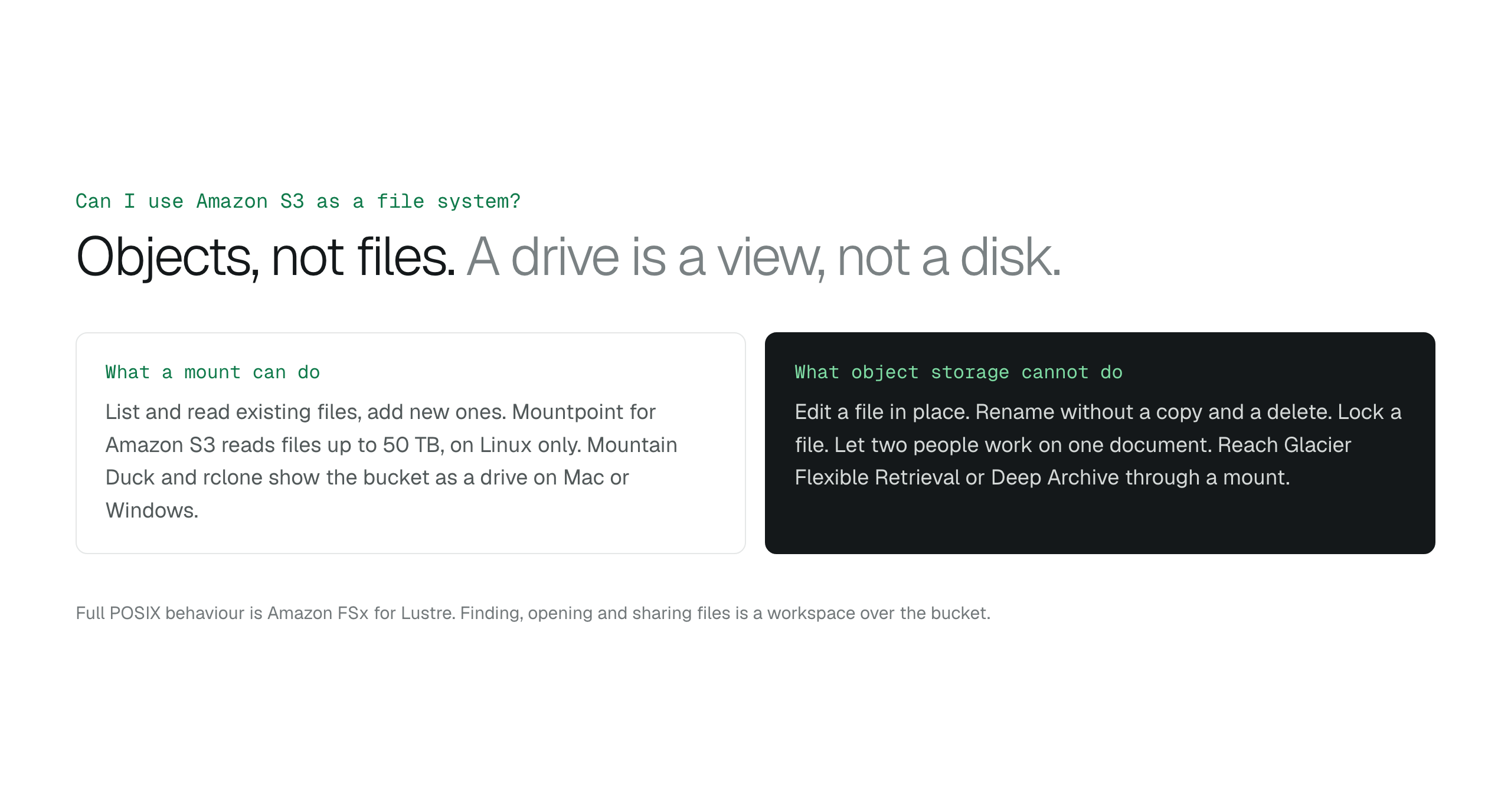
S3 is object storage, not a file system: no in-place edits, no renames without copying, no locks. Mountpoint (Linux, read and create only), Mountain Duck and rclone can present a bucket as a drive for one technical user, and FSx for Lustre is the AWS answer when a workload truly needs POSIX. A team that wants to find, open and share files is better served by a workspace that reads the bucket in the browser.
Not as a drop-in replacement. Amazon S3 is object storage: every file is a whole object with a key, so there is no editing a file in place, no renaming without copying, no file locking and no two people working on the same document at once. You can mount a bucket so it appears in a file manager, and for reading and adding files that works well. For anything that expects a disk to behave like a disk, it does not.
What makes S3 different from a file system
A file system lets a program open a file, change a few bytes in the middle and close it. S3 only knows whole objects. Saving a change means uploading the whole object again, and a "rename" in the console or the CLI is a copy to the new key followed by a delete of the old one. Nothing stops two people from uploading over each other, because there are no locks. Folders are a display convention over key prefixes, which is why an empty folder cannot exist on its own.
The upside is the reason businesses keep files there: no size planning, no volumes to grow, storage classes that cost less as files go cold, versioning, replication and retention locks as bucket settings.
- No in-place edits: a change is a new upload.
- Rename is copy plus delete.
- No locks and no co-authoring.
- Folders are prefixes, not directories.
Mounting a bucket as a drive
Three tools present a bucket as a drive, each with limits worth knowing before a team relies on it.
AWS positions Mountpoint for read-heavy workloads such as data lakes, training sets and rendering, and points teams that need full POSIX behaviour at Amazon FSx for Lustre, which can link to a bucket. For an office, Mountain Duck or rclone gives one technical person a drive; it does not give a finance team previews, sharing or an audit trail, and each person mounting the bucket needs their own AWS credentials.
| Tool | Platform | What it can do |
|---|---|---|
| Mountpoint for Amazon S3 | Linux only, free, from AWS | List and read existing files up to 50 TB, create new ones. Cannot modify existing files, delete directories, follow symbolic links or lock files. Cannot reach Glacier Flexible Retrieval, Deep Archive or the Intelligent-Tiering archive tiers. |
| Mountain Duck | macOS and Windows, per-seat licence, 14-day trial | Mounts a bucket in Finder or File Explorer for drag-and-drop work. |
| rclone mount | Any platform, free and open source | Command-line mount, best for servers and scripted jobs. |
What a team usually wants instead
Most people asking this question do not need a file system. They need to find a file, open it without downloading, send it to someone outside the company and know who did what. That is a browsing and sharing problem, and it is solved by a workspace over the bucket rather than by a mount. The files stay as objects, with every S3 feature intact, and the drive-like experience lives in the browser.
A browser workspace instead of a mounted drive
BucketDesk connects to your bucket through a scoped IAM role deployed with CloudFormation, so nobody installs a client or holds access keys. People sign in to BucketDesk, browse folders, open PDFs, images and Office files in the browser, and on Standard share links that expire and record every open. Uploads and deletes with confirmation arrive on Ultra, and every action lands in the Activity log.
Plans and pricingSee every feature with its plan and limits
Minimum is free for one bucket. Standard is $100 a month, Ultra $350 with a one-month free trial.
Primary sources
Discussion
0 comments · open to guests · moderatedLiked this? Get the next article by email. No schedule, no digest, one click to leave.