A Guide to Data Residency Requirements in 2026
Data residency requirements explained: how residency, localization and sovereignty differ, and how to keep S3 files in the region your rules require.
Data residency requirements are met by choosing the region your rules require, keeping files in storage you own, and checking that every connected tool respects that region.
You sit in a glass-walled conference room in Berlin, reviewing a service agreement that requires all customer records to remain within the European Economic Area. Your lead developer has just informed you that your current analytics engine processes metadata through a cluster in Northern Virginia, which means your firm is violating its contract.
Data residency is the specific physical and geographic location where an organization stores and processes its digital assets. While the cloud appears to be a borderless utility, every byte of information occupies space on a physical server governed by the laws of a specific jurisdiction. National regulations or internal corporate policies often dictate these residency requirements to protect sensitive information from unauthorized foreign access.
This guide clarifies the distinctions between residency, localization, and sovereignty to help you build a compliant infrastructure. You will learn to identify where third-party tools break the residency chain and how to use infrastructure-native file management to keep data under your direct control. By following these steps, you can audit your file-sharing workflows to ensure that your 2026 compliance strategy meets the standards of modern regulatory enforcement.
Data residency requirements say where your files must be stored and processed, and the answer is a physical region, not a vendor promise. To meet them, choose the region that matches your rules, keep files in storage you own, and check that every tool that touches those files respects the same region.
A German company that agrees to keep customer records inside the European Economic Area breaks that contract the moment an analytics tool copies metadata to a cluster in Northern Virginia. This guide separates residency, localization and sovereignty, shows where third-party tools break the residency chain, and ends with a five-step audit.
What data residency requirements mean for your files
When a financial services firm in Singapore initiates a cloud migration, the architecture team must select a specific geographic region from a provider’s management console. This choice represents more than a strategy for reducing latency or improving application load times. It determines the specific legal jurisdiction under which that data falls. Despite the abstract nature of "the cloud," every piece of information processed by an organization occupies a physical footprint on a server rack located within a defined national border.
Data residency is the formal designation of the physical and geographic location where an organization’s digital assets are stored and processed. This placement is rarely a matter of convenience; it is a requirement typically mandated by national regulations, industry-specific standards, or internal corporate governance policies. These mandates ensure that sensitive information remains subject to the privacy laws and sovereign authority of a specific country. Because digital assets are legally tethered to the ground they occupy, failure to align storage locations with these frameworks can lead to significant compliance risks.
The modern digital environment often feels borderless, yet the infrastructure supporting it is entirely bound by hardware. A database might be accessed by users globally, but the magnetic or flash storage holding those bits exists in a climate-controlled facility with a street address. Organizations looking to implement these standards must understand the technical specifics of their storage configurations, such as the BucketDesk workspace bucket requirements, to ensure their infrastructure aligns with local mandates. Ultimately, data residency serves as the bridge between the fluid nature of digital information and the rigid, physical boundaries of international law.
Three distinct terms govern your geographic data strategy
A German company moving customer records to a cloud provider might assume it is simply choosing a storage solution. However, this decision involves more than technical specifications because the firm must account for competing jurisdictional claims. This intersection of geography and law is where the umbrella of data residency defines how information is handled across borders. Understanding these nuances is critical for compliance, as the legal weight of where data sits has shifted from a technical preference to a statutory mandate.
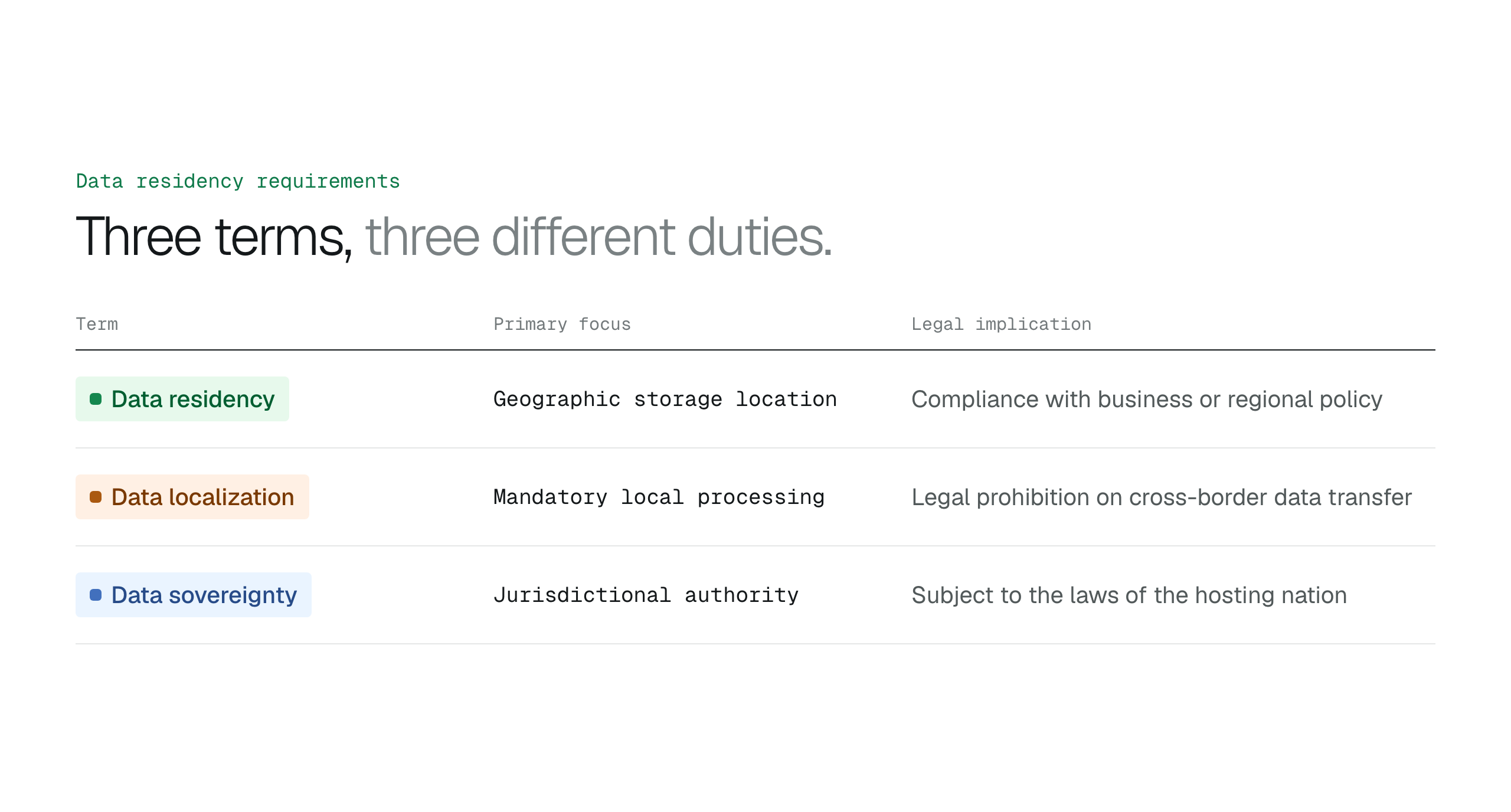
Data residency refers to the physical or geographic location where an organization chooses to store its data, often for tax or policy reasons. Data localization carries more legal weight. It is a requirement that data created within a specific jurisdiction remain within its borders. While residency is often a business choice influenced by regional regulations, localization is a strict legal obligation that forbids the export of raw data. Organizations must carefully review their terms of service to ensure provider infrastructure aligns with these specific geographic mandates.
Data sovereignty represents the highest tier of legal complexity. It dictates that data is subject to the laws of the nation in which it is physically located. This means that if a company’s data resides in a specific country, that government may claim legal jurisdiction over it, regardless of where the company is headquartered. This creates a scenario where the physical location of the server determines which privacy and surveillance laws apply to the information. This distinction is vital because sovereignty can override the privacy protections of a company’s home nation.
These three concepts overlap but serve different regulatory functions. A residency strategy might satisfy a client's request for low latency, but only a localization strategy will satisfy a government's demand for data to stay within its territory. Sovereignty ties these physical locations to the legal reality of government access and control. As organizations operate, distinguishing between these terms ensures that geographic data strategies remain both legally compliant and operationally efficient.
Term · Primary Focus · Legal Implication.
Data Residency · Geographic storage location · Compliance with business or regional policy.
Data Localization · Mandatory local processing · Legal prohibition on cross-border data transfer.
Data Sovereignty · Jurisdictional authority · Subject to the laws of the hosting nation.
Geopatriation emerges as a dominant 2026 technology trend
An enterprise operating across three continents recently discovered that its centralized cloud repository in Northern Virginia no longer met the strict privacy mandates of its European and Asian subsidiaries. To resolve this, the organization began the process of geopatriation, physically and logically migrating data back to servers located within the specific jurisdictions where the information originated. This move represents a broader industry pivot. Geopatriation is the deliberate act of returning data to its home country to ensure it falls under local legal protections. This practice has become the standard response to a global regulatory environment that increasingly demands local data custody.
The transition toward localized storage is no longer a niche concern for highly regulated sectors like banking or healthcare; it is now a core component of general enterprise IT. Geopatriation is a Gartner Top 10 Strategic Technology Trend. IT departments are moving away from the "global cloud" ideal toward a "sovereign cloud" reality, where the physical location of a server is as important as the encryption protocols protecting the data it holds.
This strategic shift requires a complete overhaul of how organizations approach vendor selection and infrastructure design. Rather than seeking the lowest latency or highest compute density regardless of location, IT leaders are now auditing cloud providers based on their ability to guarantee data residency within specific borders. Companies are investing in distributed architectures that allow for localized processing while maintaining a unified management layer. By integrating geopatriation into their long-term planning, enterprises are building resilience against shifting geopolitical tensions and ensuring that their data handling practices remain compliant with the rigorous standards established. This focus ensures that data is not just an asset, but a legally protected entity tied to its place of origin.
Regulatory enforcement carries record-breaking financial risks
In May 2023, European regulators ordered Meta, the parent company of Facebook, to pay a record-breaking USD 1.3 billion. This penalty resulted from the organization’s failure to meet strict data protection standards for transferring and storing user information across borders. This enforcement action signaled to the global market that regulatory bodies will impose financial penalties large enough to damage the balance sheets of even the largest technology firms. Professionals should verify specific penalty caps on official regulatory portals because these figures change based on new legislative amendments.
The catalyst for this era of aggressive enforcement was the implementation of the GDPR in May 2018, which established a legal framework covering all aspects of how personal data must be handled. By codifying the rights of individuals over their information, the regulation forced a fundamental change in how corporations design their digital storage systems. The massive fine against Meta underscores the reality that data residency is a legal mandate. There are high-stakes consequences for those who mismanage the physical location of their data processing.
The urgency surrounding compliance stems from the fact that these financial risks are no longer theoretical. When a business fails to meet residency requirements, the fallout extends far beyond the initial fine. Legal fees, mandatory system overhauls, and the potential suspension of data flows can paralyze operations for months. Regulators now possess the infrastructure to monitor cross-border data movements with greater precision. This makes it difficult for firms to overlook localization requirements. Consequently, the cost of building a compliant infrastructure is now viewed as a necessary insurance policy against the much higher cost of regulatory litigation.
As other jurisdictions continue to adopt models similar to the European standard, the complexity of managing these risks increases. Every region now presents a potential point of failure where a single oversight in data localization can trigger a cascade of audits and penalties. For a professional who is not a compliance specialist, understanding the financial gravity of these regulations is the first step in advocating for the resources required to secure data sovereignty. The regulatory pressures of 2026 demand a proactive stance, where compliance is integrated into the core financial strategy of the business.
Third-party access often breaks the residency chain
An enterprise selects an AWS region in Frankfurt to meet European data residency requirements, ensuring all customer files stay within EU legal jurisdiction. The infrastructure is localized and security policies are rigid. However, the data residency chain often breaks when the team integrates a traditional third-party SaaS tool to organize or search those files. Most standard software-as-a-service platforms require data to be ingested or cached on the vendor’s own central servers to work. If those servers sit in a different jurisdiction, the data has emigrated. This movement nullifies the compliance efforts of the primary infrastructure.
This disconnect happens because most cloud-based software uses a centralized service model. To provide a user interface, search indexing, or collaboration features, these tools move the actual files or their unencrypted metadata into the vendor’s database. For organizations navigating complex data residency requirements, this creates a significant hidden risk. Even if a vendor claims high-level compliance, moving data across borders for processing can trigger regulatory violations. The chain of residency is only as strong as the most permissive third-party tool in the stack. Traditional SaaS often acts as a bridge that leads data out of its mandated region.
BucketDesk changes where the files live. Instead of pulling data into a proprietary cloud, it works as a management layer on top of your own AWS buckets. Your files stay in the original S3 bucket, protected by your own encryption settings and IAM policies, and BucketDesk keeps no copies. Previews and downloads stream from your bucket when someone opens them, and Word, Excel and PowerPoint files open in a document server BucketDesk runs, which fetches the file with a short-lived link and holds it only while the document is open. BucketDesk itself runs on AWS in the United States (us-east-1), so check with your compliance team that this short-lived access fits your rule before you connect a bucket in another region. To understand the technical specifics of how this permission model functions, professionals can review the details of what BucketDesk can do in your AWS account to see how it maintains isolation. Because the files stay in your bucket, the storage location you chose remains the location of record.
Verify compliance through infrastructure-native file management
A compliance officer discovers that customer files, intended for a Frankfurt data center, have been mirrored to a US-based cache by a third-party file-sharing tool. This scenario highlights the necessity of a workflow audit to determine whether an organization maintains direct control over its storage infrastructure. To identify which residency category a workflow falls into, teams must trace the path of a document from upload to rest. If a file is moved to a vendor’s proprietary storage, the organization loses the ability to enforce geographic boundaries at the hardware level. Conversely, keeping data within organization-owned cloud buckets ensures that residency is governed by the organization’s own security policies rather than a third party's internal logic.
Managing these buckets requires a shift away from static credentials. While long-lived IAM keys were once common, they present a significant risk because they can be leaked or misused to bypass regional restrictions. Organizations should instead rely on infrastructure-native identity management, specifically through AWS roles. This approach allows external services to access files without the organization ever relinquishing ownership or moving the data to an external silo. For those implementing these permissions, understanding the AWS IAM External ID is essential for preventing unauthorized cross-account access while maintaining strict data locality.
By implementing role-based access, an organization ensures that data residency remains a function of the infrastructure itself. When a service reaches a file through a role, the bucket and its region remain yours, and you can revoke access at the source by deleting the role. This architecture prevents the "black box" storage problem where compliance depends on a vendor's promise rather than verifiable infrastructure settings. Auditing these workflows to ensure they rely on native roles rather than data exports is the most reliable way to guarantee that residency requirements are met in a multi-region environment.
Human-centric interfaces bridge the gap between IT and compliance
A marketing manager needs to review a high-resolution video asset stored in a restricted Amazon S3 bucket located in a specific European region to satisfy local data residency requirements. If the only way to view that file is through a complex technical console or by downloading the file to a local machine, the manager may find the process too cumbersome. To save time, they might request a colleague to send the file via a consumer-grade messaging app or a third-party file-transfer service. This shift to shadow IT immediately moves sensitive data out of the managed environment and into an unverified jurisdiction, creating a silent but significant compliance breach.
Providing a human-centric interface over S3 allows non-technical staff to interact with data exactly where it lives. When users view content in the browser, the file stays in your bucket and under your access policies. This eliminates the "download and re-upload" cycle that traditionally fuels shadow IT. Understanding How to preview files in Amazon S3 without downloading them is essential for maintaining a secure perimeter while satisfying the speed requirements of modern business workflows.
By making the compliant path the easiest path, organizations reduce the risk of accidental residency violations. Shadow IT often emerges from technical friction rather than a desire to bypass rules. A user-friendly interface ensures that data residency requirements are a baseline feature of the daily workflow rather than a hurdle to be cleared. When the native infrastructure supports secure, localized sharing and viewing, the incentive to use external, non-compliant tools disappears, ensuring that data stays within the sovereign boundaries established by the IT department.
What are the 7 GDPR requirements?
A manager reviewing a vendor contract must ensure the processing adheres to lawfulness, fairness and transparency, purpose limitation, data minimization, accuracy, storage limitation, integrity and confidentiality, and accountability. These seven principles form the core of GDPR, dictating how personal information is handled. They ensure that data protection is a continuous framework for organizational responsibility rather than a one-time technical checklist.
Which countries have data residency requirements?
A multinational firm expanding into markets like China, Russia or Saudi Arabia will encounter laws that require some data to be stored locally. The specific rules vary by jurisdiction and by type of data. This global patchwork forces companies to adopt flexible infrastructure that can pin data to specific geographic regions.
What are the requirements for data residency compliance?
A compliance officer auditing a cloud migration must verify the physical location of storage hardware and identify any third-party access points that might break the residency chain. Meeting data residency requirements involves maintaining a clear chain of custody and using infrastructure-native file management to prevent unauthorized geographic transfers. These steps ensure digital assets remain within the specific legal boundaries.
Deciding Between Geographic Agnosticity and Hard Sovereignty
Imagine a regional regulator requests a real-time audit of your European user base, only for you to discover that your cloud provider shuffled that metadata to a secondary node in another hemisphere during a peak-load rebalance. This specific failure highlights the broader reality of data residency requirements: geographic intent is meaningless without granular, infrastructure-level control. The lesson for every professional is that you must decide whether to treat location as a vague operational suggestion or as a hard-coded constraint within your technology stack.
Catalog every endpoint, documenting the physical coordinates of every server housing your sensitive digital assets.
Define jurisdictional boundaries, listing the specific legal mandates that apply to each category of your stored information.
Verify provider transparency, requiring your vendors to prove that their automated load balancing respects your geographic constraints.
Model failover scenarios, checking if your disaster recovery site resides within a compliant legal territory.
Review access logs, confirming that administrative personnel in different regions cannot view data restricted to a specific zone.
Focus on building a resilient architecture that survives the next wave of global privacy legislation rather than just reacting to current audits. BucketDesk offers a unified platform to manage these complex infrastructure-native file requirements. Visit BucketDesk to start your compliance transition.
Keep your files in your own S3 bucket
Connect your bucket to BucketDesk through an IAM role you create, and your files stay in the bucket and region you chose. Staff browse, preview and share from the browser, so nobody needs to export a copy to a tool you have not checked.
- Create the role
launch the CloudFormation template in your AWS account
- Pick the scope
limit access to one bucket or prefix in your region
- Open files
browse and preview them from the browser
BucketDesk workspace bucket requirementsPreview files in Amazon S3 without downloading themIAM roles and external IDs explained
Discussion
0 comments · open to guests · moderatedLiked this? Get the next article by email. No schedule, no digest, one click to leave.