Best Data Archiving Software for 2026 Compliance
Data archiving software for 2026 compliance compared: Veritas, Scale Computing, Nutanix, OpenText and BucketDesk on capture, security and cost.
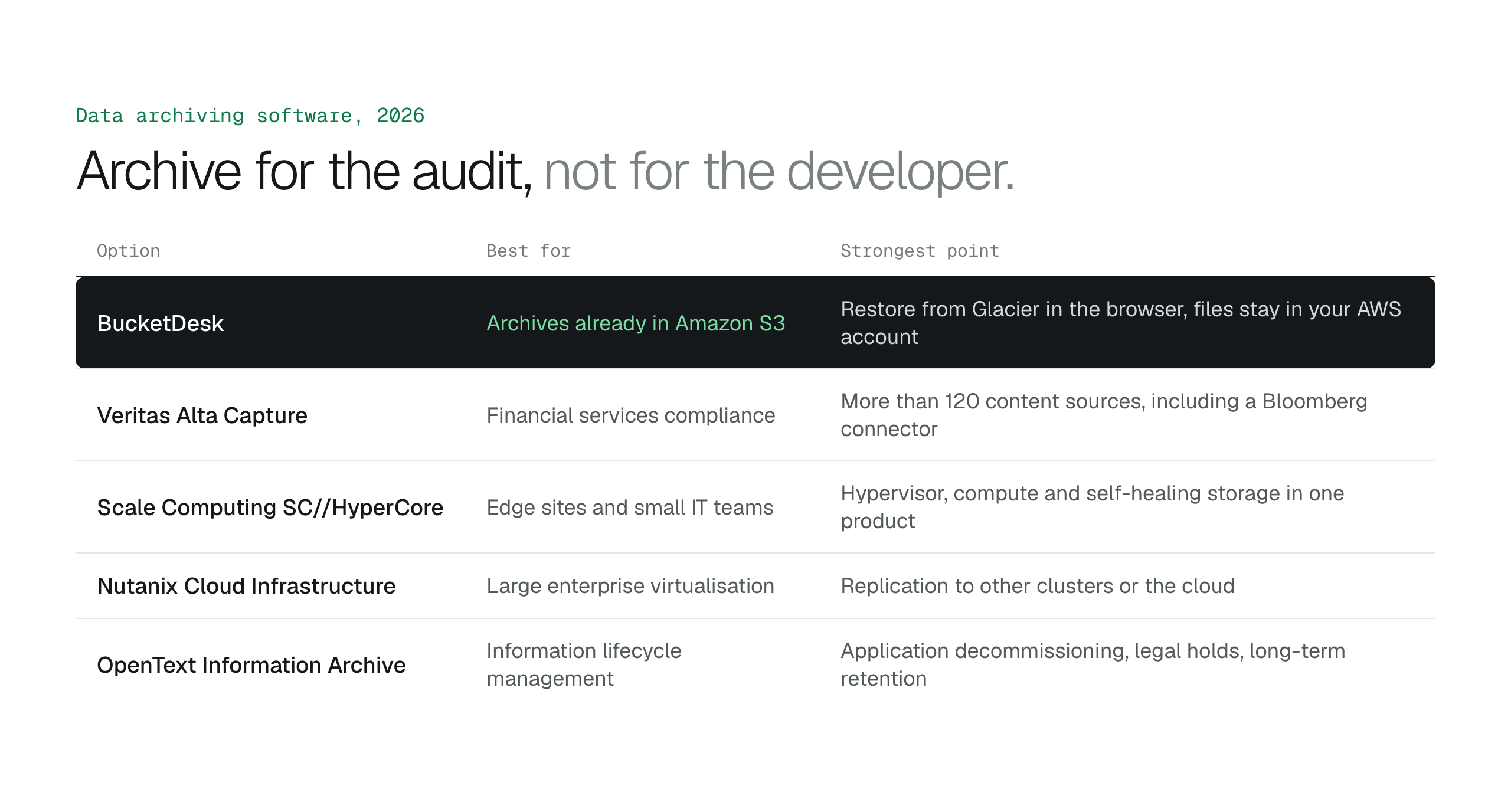
The best data archiving software for 2026 compliance is the one your compliance team can use without a developer. Veritas Alta Capture captures specialised communication streams, Scale Computing and Nutanix archive at the infrastructure layer, OpenText manages the enterprise information lifecycle, and for archives already in Amazon S3, BucketDesk gives non-technical staff a browser interface to find, preview and restore files while the data stays in your own AWS account.
Data archiving software moves inactive data into long-term storage and keeps it searchable and retrievable for audits. The best data archiving software for 2026 compliance is the one a compliance officer can use without a developer: it captures every regulated channel, keeps the records in storage you control, and lets a non-technical person find and restore a file in minutes.
Backups are temporary recovery points. Archives are permanent, searchable records held to a legal standard. Teams that confuse the two end up with data that is stored but unretrievable during an audit, because the records sit in a cold storage tier that needs a developer and a command line to bring back.
This guide compares Veritas Alta Capture for specialised communication streams, Scale Computing and Nutanix for infrastructure-level archiving, OpenText for the enterprise information lifecycle, and BucketDesk for archives that already live in Amazon S3.
Key takeaways for choosing data archiving software
Each check narrows the shortlist before you compare features.
- Residency: keep archived data inside your own AWS account for control over security and cost.
- Capture: pick software that handles structured data and specific communication streams such as Bloomberg.
- Retrieval: choose a platform with a non-technical interface for Glacier restores, so IT is not the bottleneck.
- Access: verify that the tool connects to AWS through a role instead of shared IAM access keys.
Selection criteria for modern data archiving software
A compliance officer needs one email thread from four years ago to satisfy a sudden audit request. If the archive requires a command-line interface or manually rotated encryption keys, the retrieval stalls and the legal deadline is at risk. Modern evaluation therefore goes beyond capacity: it measures how easily the organisation can work with its cold storage.
The security model is the first filter. Traditional systems rely on manual key management that burdens IT, while the current leaders use keyless role connections or automated KMS integrations, which remove lockouts caused by human error. Accessibility for non-technical staff is the second filter: a platform is only as useful as the legal or HR department's ability to use it without a developer.
The third filter is how the software manages long-term storage tiers such as Amazon S3 Glacier or Azure Archive Storage. The best tools provide a graphical way to move data between hot and cold tiers, rather than lifecycle scripts. Tools that hide the complexity of the cloud keep data compliant and retrievable whatever the underlying storage.
S3 access for non-technical teams: the complete guideArchiving files in Amazon S3: Glacier, lifecycle rules and recovery
Veritas Alta Capture leads for specialized communication streams
A financial services firm under audit must produce more than a trail of emails. When the auditor asks for the full context of a trade discussed over a proprietary terminal or an internal messaging app, the firm finds out whether its data archiving software captured every interaction and metadata field. Professional communication is fragmented across dozens of platforms, and the ability to ingest and normalise those streams is what separates a backup from an archive that meets regulatory standards.
Veritas Alta Capture captures more than 120 applications and channels and can be extended to proprietary content sources, so custom-built applications and new social tools land in one central archive under the same retention and discovery rules as email. Its Bloomberg connector captures Bloomberg messages, attachments and the metadata that gives a trade its context, and preserves the structure of the conversation for rapid retrieval during an investigation.
Veritas focuses on the capture step, securing data the moment it is generated. Automated ingestion of these streams maintains a defensible chain of custody and removes the human error and deliberate deletion that manual capture invites. Licensing is per subscription, and firms that need several connectors should confirm current terms on the vendor's page, because the total cost over a multi-year period depends on it.
Scale Computing and Nutanix offer infrastructure-level archiving
A data centre manager running a network of retail branches accumulates transaction logs and surveillance footage, and moving all of it into a separate archiving application becomes a bandwidth and budget bottleneck. Instead of layering new software over existing hardware, many organisations retain data at the storage layer of their hyperconverged infrastructure (HCI), which keeps archiving in the same environment that hosts the applications.
Scale Computing does this through SC//HyperCore, which combines the hypervisor, compute and storage in one product with self-healing storage, and is built for fleets of edge sites. Administrators manage the data from one console instead of a separate storage array. Because hardware and software are tightly coupled, verify the tiering and snapshot capabilities on the vendor's current page before relying on a given retention depth. For multi-petabyte estates, Nutanix Cloud Infrastructure, sold in Starter, Pro and Ultimate editions, replicates data to other clusters or to the cloud and moves workloads between on-premises and public clouds. Nutanix licensing is modular, so check the current plan inclusions.
The choice between the two comes down to scale and in-house expertise. Scale Computing is built for "set and forget" simplicity, which suits organisations without storage specialists or with remote sites. Nutanix offers finer controls, including data locality policies and cross-cloud replication across mixed hardware. Treating the storage layer as the archive avoids the "data tax" of moving information across the network into a standalone compliance tool, and keeps metadata and permissions intact for an audit. Teams that need an off-site second copy of the archived objects extend the on-premises infrastructure into Amazon S3 and manage that copy with BucketDesk.
| Option | Best for | Strongest point | Main trade-off |
|---|---|---|---|
| Veritas Alta Capture | Financial services compliance | More than 120 content sources, including a Bloomberg connector | Licensing per connector to confirm |
| Scale Computing SC//HyperCore | Edge sites and small IT teams | Hypervisor, compute and self-healing storage in one product | Hardware-dependent scaling |
| Nutanix Cloud Infrastructure | Large enterprise virtualisation | Replication to other clusters or the cloud | Modular licensing to check |
| OpenText Information Archive | Information lifecycle management | Application decommissioning, legal holds, long-term retention | High implementation overhead |
| BucketDesk | Archives already in Amazon S3 | Browse, preview and restore from Glacier in the browser; files stay in your AWS account | Restores need the Ultra plan |
Enterprise content management when the content already lives in Amazon S3
OpenText addresses the enterprise information lifecycle
When a global enterprise acquires a subsidiary, it inherits ageing ERP systems and disconnected databases. Keeping those applications running only to satisfy retention requirements drains IT and widens the attack surface. OpenText exists for this: it ingests the data into a central, governed repository so the original software and its licences can be retired.
OpenText provides a structured framework for capturing, indexing and preserving large volumes of unstructured content. It suits large-scale document archiving where the priority is a clear audit trail and records that stay searchable and tamper-proof for decades, which matters in industries whose retention mandates outlast the active life of the data. Legal holds are the critical control: when litigation or a regulatory inquiry starts, administrators lock specific records against deletion or modification without disrupting the wider archiving schedule.
The architecture that makes OpenText a powerhouse for traditional enterprise environments is a hindrance in cloud-native ones. It excels at structured legacy data and deep document hierarchies, and lacks native agility for high-velocity S3-based workflows. Teams that work mainly in AWS or GCP find its implementation overhead and rigid structure a poor fit for object-storage-centric work, and a lighter tool that manages the cloud storage they already own is the faster route for document-heavy workflows.
Why human-centric interfaces matter for AWS S3 archiving
A compliance officer receives an urgent discovery request on a Tuesday morning and must retrieve three-year-old project logs stored in the S3 Glacier Deep Archive storage class. Under a standard setup that means the AWS Management Console, IAM permissions and a CLI command to start the restore job. For someone whose expertise is regulatory law or project management, the task becomes a high-friction dependency on the IT department.
That friction is the gap in the 2026 data archiving market. Backend storage has become cheap and reliable, while the software used to manage it stays technical: most platforms prioritise API calls and encryption and neglect the person who needs the data. A human-centric interface bridges the gap by letting non-technical teams manage cloud storage through a familiar file-explorer layout.
BucketDesk takes this approach for Amazon S3. Instead of writing JSON policies, users preview files in the browser and request a Glacier or Deep Archive restore from the file's panel, choosing the retrieval tier and how long the restored copy stays readable, so a department head does not have to learn the AWS console. The architecture behind it maps professional workflows onto cloud-native services while keeping the files in the customer's own AWS account.
Compliance is an operational necessity, not a "set and forget" technical requirement. When archiving software is too hard for the average employee, data ends up on local drives or unmanaged services to avoid the official archive. A human-centric interface keeps long-term storage accessible, so when the audit comes the data is both preserved and retrievable by the people who need it.
Inside BucketDesk: the AWS architecture behind your file workspaceHow to restore files from S3 Glacier Flexible Retrieval and Deep ArchiveGovernance or compliance mode? Choosing an S3 Object Lock mode
What is the best software for storing data?
Scale Computing and Nutanix are the top choices for integrated data storage and archiving. When a server room reaches physical capacity, these infrastructure-level platforms scale without adding a separate management layer. Nutanix manages active workloads and long-term storage pools through one consolidated interface.
What is the best data archiving software?
Veritas Alta Capture and OpenText are the industry standard for specialised and enterprise-wide data archiving. A compliance officer facing a sudden audit needs software that indexes and retrieves specific records across fragmented platforms. Veritas Alta Capture captures more than 120 applications and channels.
What is the best software for historical archiving?
OpenText is the leading solution for historical archives and long-term information lifecycles. Healthcare providers must keep records accessible for decades, which requires software that prevents data obsolescence as file formats evolve. OpenText keeps legacy documents searchable and compliant with retention policies for their whole multi-decade life.
What is some free archiving software?
Duplicati and 7-Zip are reliable free tools for basic compression and archival. A small business owner packages old logs with 7-Zip before moving them by hand to a low-cost cloud tier. Duplicati is free and open source, encrypts data with AES-256 before it leaves the machine, sends only changed blocks, and backs up to providers such as AWS S3, Azure Blob Storage and Backblaze B2. Neither tracks compliance the way enterprise suites do.
Selecting your 2026 data archiving strategy
An audit request arrives on a Friday afternoon for one Slack conversation or Zoom transcript recorded three years ago. If the data archiving software needs a manual script and six hours of re-indexing to find that thread, the compliance framework has already failed. Archiving is a discovery problem, not a storage problem: success is how quickly cold data turns into verifiable evidence for a regulator. Answer these five questions before committing to a vendor.
- Map all sources: identify every communication platform and database that generates regulated business records.
- Define retention periods: set specific timelines for how long each data category must stay immutable and accessible.
- Test search latency: confirm a non-technical administrator can locate a record within minutes rather than days.
- Calculate egress costs: account for the fees of moving large volumes out of deep-tier storage.
- Confirm data portability: keep records in open formats so a future migration is not blocked by vendor lock-in.
Archive in your own S3 buckets with BucketDesk
BucketDesk is a file workspace for the Amazon S3 buckets you already own. It connects through an AWS role, and your archived files stay in your AWS account.
- Connect
link your bucket through an AWS role instead of pasting access keys.
- Find and preview
browse, search and open PDFs, images and, from the Standard plan up, Office files in the browser.
- Restore
pick a file in Glacier or Deep Archive, choose Standard or Bulk retrieval and request the restore from the file's panel on the Ultra plan. AWS bills the retrieval to your account.
When to move S3 files to Glacier, and how to do it in three steps
The Minimum plan is free for one bucket. Ultra, which includes Glacier restores, is free for the first month, then $350 a month.
Primary sources
Discussion
0 comments · open to guests · moderatedLiked this? Get the next article by email. No schedule, no digest, one click to leave.